
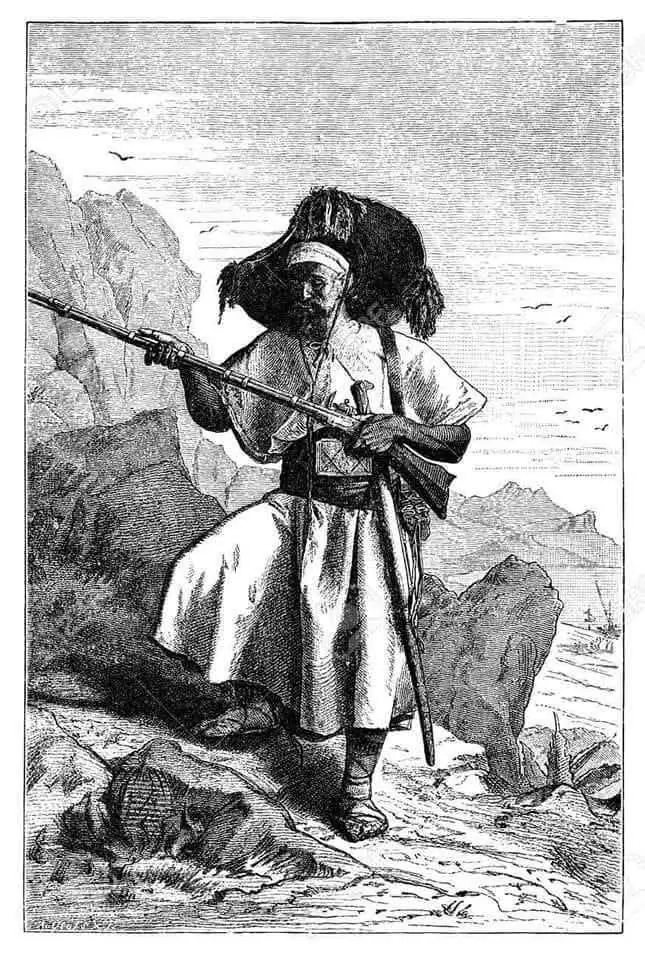
Before writing became the standard, even before Kabylie entered the history books, there was already a voice. It belonged to a man who never held a pen, yet whose words have traversed three centuries without ever fading. Words carried, from mouth to mouth, by a people who turned their memory into a fortress. Youcef Ou Kaci is not just a name in a book: he is living proof that an oral culture can be just as solid, as learned, and as dignified as any written tradition.
Identity
| Kabyle Name | Yusef U Qasi |
| Tribe | At Jennad |
| Birthplace | Ait Gouaret |
| Region | Greater Kabylie |
| Birth | c. 1680 |
| Death | Second half of the 17th century (a later source suggests 1747) |
| Burial | Ait Gouaret, Timizart commune, Ouaguenoun district, Tizi-Ouzou province |
| Title | Amusnaw (Wise-learned man) |
The oldest known Kabyle poet of the oral tradition
Youcef Ou Kaci occupies a unique place in Kabylie’s cultural history: he is considered the oldest voice preserved by oral memory. Unlike the poets who would follow him, such as Si Muhend U M’hend in the 19th century, he left no written trace during his lifetime. His poetry survived only because it was transmitted, recited, and re-sung from generation to generation until its late collection, notably by the writer and anthropologist Mouloud Mammeri in his reference work, Poèmes kabyles anciens (Ancient Kabyle Poems).
This purely oral transmission explains why the details of his life remain hazy: the dates, the circumstances of his death, and the exact scope of his work belong more to collective memory than to verifiable archives. This is a common trait among the great founding figures of Kabyle poetry, whose lives are told almost as much as their verses are recited.
Poetry as a witness to his time
Youcef Ou Kaci was not a scholar in the academic sense: for him, poetry was a gift rather than something learned from books. He traveled across Kabylie and composed based on what he observed, reporting and commenting—sometimes with a sharp distinction between right and wrong—on the events that agitated the tribes of his era.
His verses thus constitute a precious source regarding 17th-century Kabyle society: customary law (qanun), the code of honor (nif), rivalries and solidarities between tribes, and tribal wars. Even today, some of his verses are quoted in daily life as arguments of authority, a sign of the strength that Kabyle culture places in the poetic word capable of spanning centuries without ever having been fixed in writing.
The status of amusnaw: Much more than a poet
In Kabylie, the title amusnaw refers to a wise figure who possesses vast oral knowledge, a sort of equivalent to the West African griot. As a guardian of collective memory, his word carries authority and his presence is sought after. Youcef Ou Kaci was a major incarnation of this, to the point that he was later considered a saintly figure by popular tradition.
This status was not limited to poetic art. Thanks to the audience and respect he had earned, he also played the role of mediator and arbitrator in conflicts between tribes. He is credited with ending a tribal war that pitted his own tribe, the At Jennad, against the At Yenni—two tribes that have since become allies. A poem reported by Mouloud Mammeri even recounts that the At Yenni, who admired him profoundly, went so far as to attack a village to avenge an insult made to the poet, proof of the prestige he enjoyed well beyond his own village.
Legacy
Youcef Ou Kaci’s work occupies the first section of Mouloud Mammeri’s Poèmes kabyles anciens, a foundational work for safeguarding Kabyle poetic heritage. He was also the subject of a biographical work, Youcef Oukaci, le cavalier poète (Youcef Oukaci, the Poet Horseman), by journalist Mohamed Ghobrini. Furthermore, Camille Lacoste-Dujardin devoted an entry to him in the Dictionnaire de la culture berbère en Kabylie.
Through him, an essential dimension of Kabyle culture is perpetuated: that of a society where the poetic word is not a mere ornament, but a pillar of memory, customary law, and social cohesion Tamusni (knowledge), carried and transmitted by the voice.
Principal sources: Mouloud Mammeri, Poèmes kabyles anciens; Camille Lacoste-Dujardin, Dictionnaire de la culture berbère en Kabylie (La Découverte, 2005); Mohamed Ghobrini, Youcef Oukaci, le cavalier poète.