
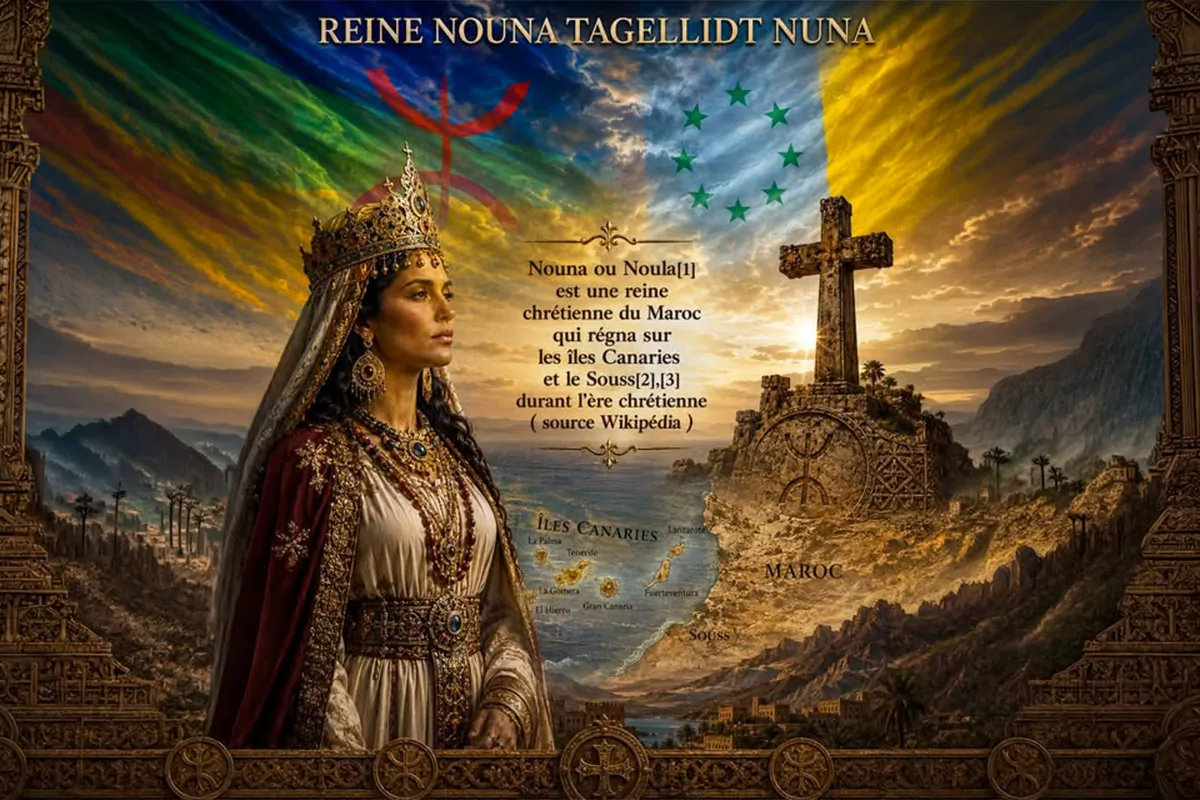
In the oral memory of southern Morocco, the story of a Christian Amazigh queen named Nouna, or Noula, circulates. It is said she arrived from the Canary Islands to rule over the Souss, reaching as far as the Seguia el-Hamra, in a very distant era prior to the Islamization of the region. No established historical chronicle allows us to date or confirm her reign: her existence rests almost entirely on toponymy, oral traditions, and 19th-century travel journals.
Traces of a name in the landscape
It is in place names that the legend of Nouna has survived best. The Oued Noun (Noun River), which gives its name to an entire region of southwestern Morocco, is, according to oral tradition, a corruption of “Nouna en-Nasraniyya,” meaning “Nouna the Christian.” The French ethnologist Odette du Puigaudeau, who extensively surveyed this region in the 20th century, reported that the queen allegedly engraved her own name on the ruins of the Agadir Nouna site, near Tiliwîn. A nearby mountain pass, on the left slope of the Oued Assaka, also bears the name Tizi-n-Tarroumit, or “The Christian Woman’s Pass.”
An archival document demarcating a property in the qsar of Tissegnan also mentions the “plain of Oued Nouna” (bathat wad nûna), proof that the memory of this Christian figure has been durably inscribed in the local vocabulary, far beyond mere folklore.
A “Godmother” to an entire province
The Spanish explorer Joaquín Gatell y Folch, who traveled through the region in 1864 disguised as a Muslim merchant, already noted that Nouna was considered a sort of tutelary godmother to the entire Noun province. This account, one of the oldest on the subject, shows that the legend was very much alive in the local collective memory by the mid-19th century, well before European ethnologists systematically took an interest in it.
A claimed heritage
In Asrir, in the Noun oasis, some Amazigh families still claim today to be descendants of a Christian ancestress—a probable, albeit unverifiable, echo of the Nouna legend. This claimed lineage illustrates how a foundational narrative can structure a group’s identity, regardless of its strict historical veracity.
A legend within a broader context
The story of Nouna is not an isolated one. Pre-Saharan Morocco and the Atlas Mountains preserve several legends of Christian princesses or queens who predated Islam: for example, Queen Séita, who was defeated near Jebel Zagora by a rival kingdom, or the tales of Christian princesses associated with the ksar of Aït Ben Haddou. Further east, the Kahena, the Berber queen of the Aurès who resisted the early Muslim conquests, has long been a subject of debate among historians regarding whether she was Jewish or Christian. Each of these figures bears witness, in its own way, to a very real Berber Christianity in late antiquity and the early Middle Ages, before its gradual disappearance from North Africa, even if the degree of historical truth specific to each legend remains highly variable and largely unverifiable.
What can reasonably be concluded?
As it stands, Queen Nouna belongs to the realm of toponymic legend rather than documented history. No contemporary source from her supposed reign has been identified: everything we know comes from accounts collected centuries later by travelers and ethnologists who themselves recorded an oral tradition that was already ancient in their time. This does not render the narrative uninteresting; quite the contrary: it sheds light on how a region has constructed its memory around a female, Christian figure from afar—a symbol of a pre-Islamic past whose memory has crystallized in place names rather than in archives.
Note: This article synthesizes the information available on this legendary figure, particularly through the work of Odette du Puigaudeau and the testimonies of 19th-century travelers. It is important to keep in mind the largely legendary and unverified nature of this account.