
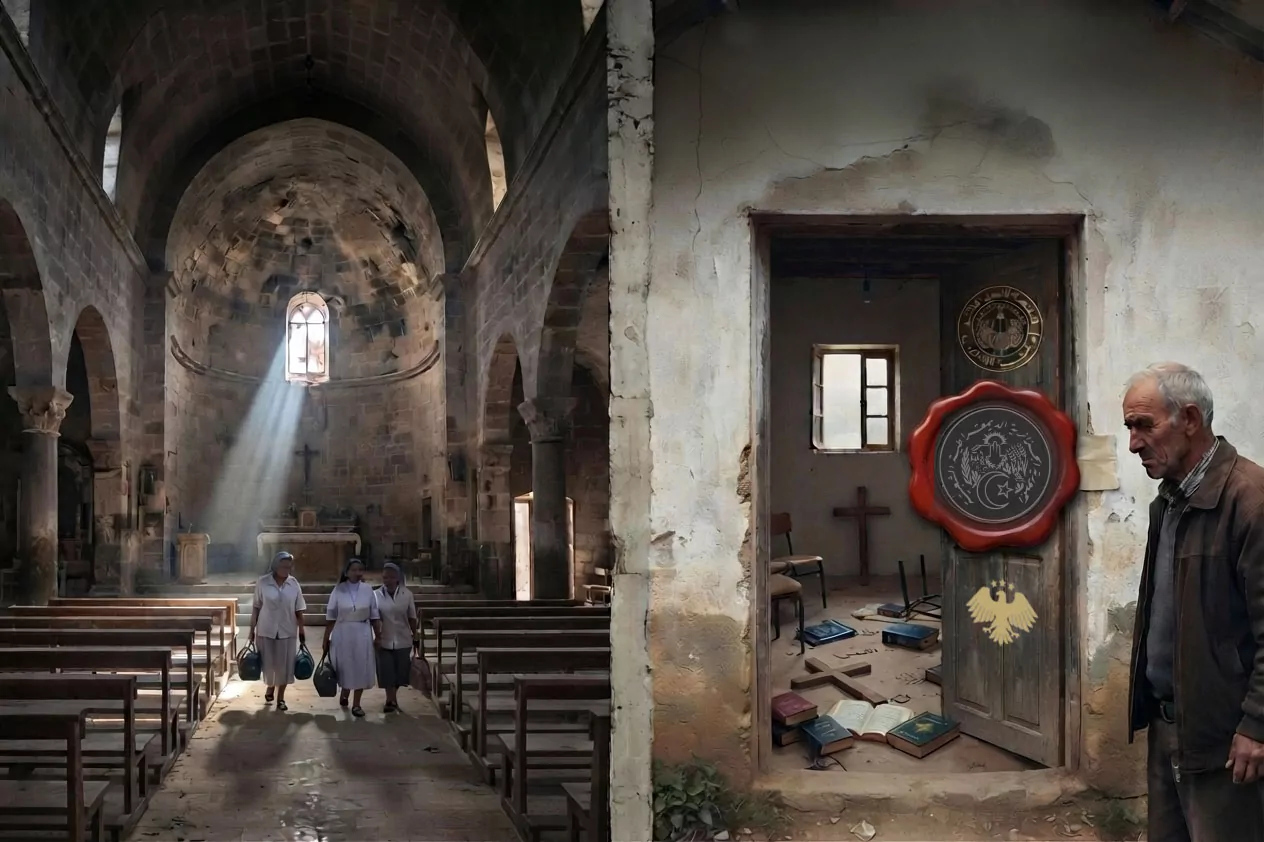
It took only a few weeks. Just a few weeks between Emmanuel Macron’s handshake in Damascus and the sober, almost administrative announcement of the departure of the Franciscan Sisters of Aleppo. A century of continuous presence is coming to an end amidst near-general indifference and a controversy just waiting to flare up.
The French president’s visit to the Umayyad Mosque a few weeks earlier had already ruffled feathers. Was this a necessary gesture of realpolitik in an exhausted Syria, or the barely veiled legitimation of a regime rooted in the Islamist movement? For a segment of the political class and observers of Eastern Christians, the question no longer even arises: France, they argue, has turned its back on its historic vocation as protector of minorities, sacrificed on the altar of appeasement diplomacy.
So when the Franciscans announced they were leaving Aleppo, the connection was made immediately. Too immediately, perhaps.
What the Latin patriarchate really says
On the ground, the narrative is more sober and of longer standing. Asked about the reasons for this departure, Mgr. Hanna Jallouf, Apostolic Vicar of the Latin Patriarchate in Syria, dismisses any circumstantial reading:
“Linking this decision to current political events, or considering it as the direct consequence of a visit or a political stance, is not based on any confirmed information. Rather, it is an interpretation that ignores the global context of the situation.”
That global context can be summed up in four words: vocations, schools, transition, exhaustion.
Religious vocations are declining everywhere, in Syria as elsewhere: a slow erosion, documented for decades, which is by no means an isolated Syrian phenomenon. In Aleppo, the presence of the Franciscan sisters relied above all on their school, the beating heart of their mission for a century. Yet this educational activity had already been reduced to a trickle, undermined by civil war, the massive Christian exodus of the 2010s, and economic collapse. The baton has now been taken up by the Salesian monks, who also have deep roots in education in Aleppo: a handoff, not a flight.
Reducing this departure to Macron’s visit means projecting an event lasting a few weeks onto an erosion measured in decades.
Kabylie: the persecution no one dares to face
Yet if there is one place where the gradual disappearance of a Christian community truly deserves attention—free from shortcuts or the instrumentalization of a diplomatic news item—it is Kabylie. There, the fate of Christians is no hypothesis: it is documented, quantified, and has been the subject of hearings right up to the French Senate and the US Congress.
Algeria is estimated to be home to nearly 150,000 evangelical Christians today, largely concentrated in Kabylie, a community born from a conversion movement specific to this Amazigh region, an ancient land of the African Church of the early centuries. Since 2016, administrative repression has taken a systematic turn: forty-seven evangelical churches have been closed, reducing religious practice to clandestinity. The figure recurs year after year in NGO reports: according to Open Doors, Algeria is among the twenty countries that persecute Christians the most worldwide, and more than seventy church leaders are being prosecuted there for practicing a non-Muslim worship without authorization. Amazigh activist Slimane Bouhafs remains under an ISTN (Interdiction de Sortie du Territoire National – Travel Ban). Exiled to Tunisia in 2018 where he had obtained refugee status from the United High Commissioner for Refugees, he was violently abducted in 2021 before being forcibly returned to Algeria. Condemned, imprisoned, and subjected to ill-treatment, Bouhafs regained his freedom in 2024 at the end of his three-year sentence. Sharing the fate of many members of the Kabyle community, he faces a rigorous obstruction of his freedoms of expression, opinion, and movement.
Behind the statistics lie individual trajectories. In November 2021, Pastor Salaheddine Chalah, president of the Protestant Church of Algeria, was arrested; the Catholic NGO Caritas was forced to close its doors in September 2022; then, in November 2023, the vice-president of that same Church was sentenced to one year in prison, alongside five church members sentenced to three years. The law mobilized for these prosecutions—a 2006 ordinance—prohibits anything that might “shake the faith of a Muslim,” a text vague enough to turn a Bible in a bag or a Christian first name into incriminating evidence.
As several researchers point out, this repression cannot be understood in religious terms alone. According to sociologist Fatiha Kaouès, the Algerian authorities readily assimilate Christian converts with autonomist militants from a region historically in tension with the central power. Faith and Berber identity are intertwined there, making the repression all the more difficult to isolate, and all the more difficult to make heard internationally.
For that is precisely where the shoe pinches: unlike the fate of Eastern Christians, which is widely commented on, debated, and instrumentalized even within French controversies, that of Kabyle Christians remains largely ignored. Successive visits by international religious leaders to Algeria have admittedly lifted a corner of the veil; but over the long term, the international community remains surprisingly silent in the face of a methodical, documented policy of church closures that has never truly been denied by Algiers.
Two stories, one lesson
There is something dizzying about holding these two situations up as mirrors of each other. On one hand, the departure of nuns in Aleppo that people are all too quick to turn into a symbol of political abandonment, whereas patiently cross-referenced facts tell an older, more mundane story: that of extinguishing vocations and closing schools. On the other hand, a very real, methodical, legally equipped repression that for ten years has been emptying Kabylie’s churches of their worshippers—yet fails to provoke either a presidential tribune or a national controversy.
The plight of Eastern Christians deserves to be examined with rigor, without yielding to the temptation of political shortcuts. That of the Christians of Kabylie simply deserves to be examined at all.