
A truth often ignored.
Mouloud Mammeri once wrote with bitterness: “…In Roman times, it was in Latin that Tertullian, Cyprian, Augustine, Fronto, Arnobius, and Apuleius wrote, although in their books one can trace indices of the Berbership (of their thought) from which they originated; for example, Apuleius recounts, in one of his works, the story of ‘Psyche,’ and this story can still be heard today in a well-known tale, that of ‘The Storm Bird.'”
Since then, and until today, the situation of the Berber language has not changed. In all countries where Berber is spoken (…) invaders succeeded one another, and each of them added his problems to those left by his predecessor. Berber has always remained in the wings. (…) For at least these three millennia, people have written in Phoenician, in Latin, in Greek, in Arabic, in French, but no one has used Berber in writing (*).
Yet we know that during the period between Late Antiquity and the early Middle Ages, there was a plethora of religious clerics, scholars, grammarians, rhetoricians, dramatists, and Amazigh philosophers who expressed themselves and/or produced their works in Greek and then Latin languages.
For example, the philosophical and theological Latin of medieval and modern Europe was not born in Rome; it was born right here in Tamazɣa, more precisely in Carthage! It was thanks to the linguistic genius of an African intellectual (Tertullian), followed by Saint Cyprian (Siferyan) and crowned by Saint Augustine (Ugastan), that the Latin world was able to equip itself with the conceptual, linguistic, and philosophical tools that shaped modern Western thought.
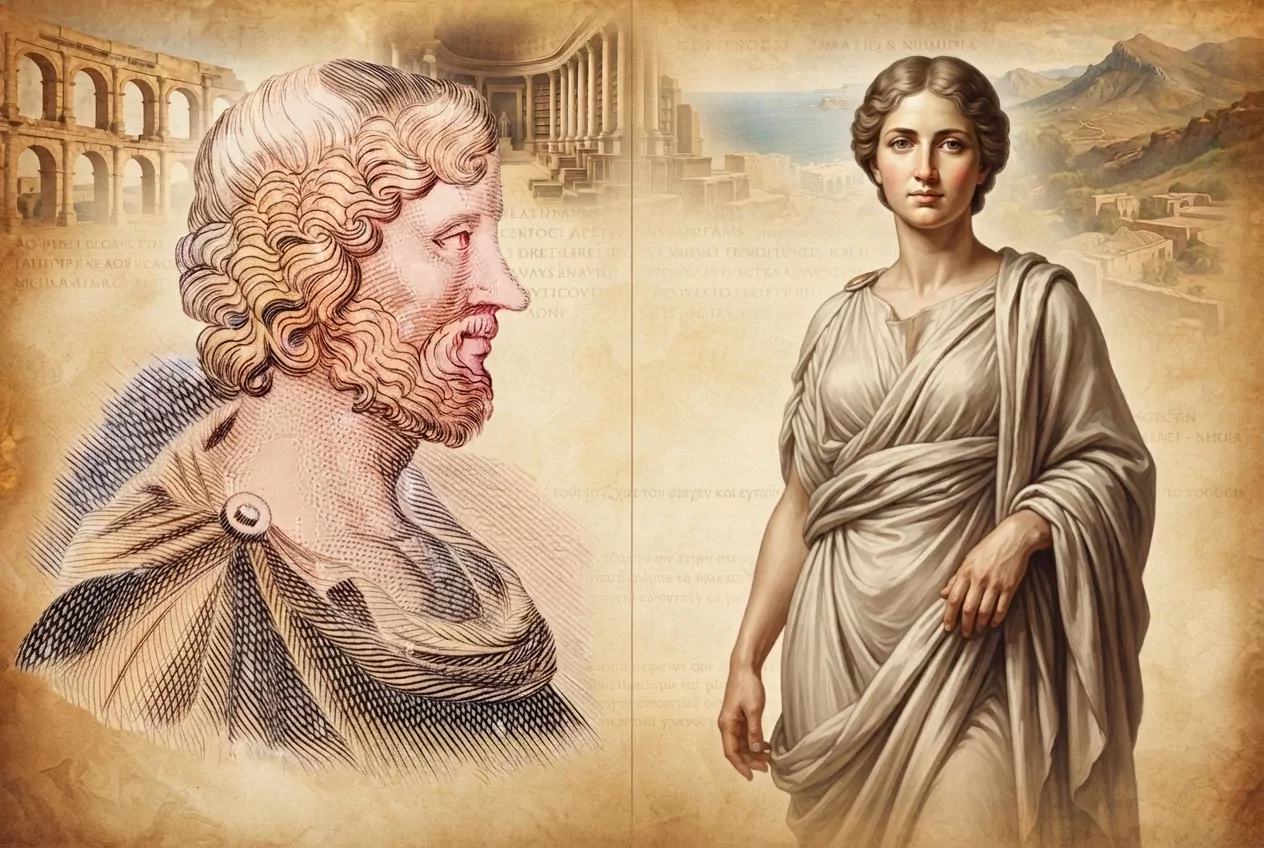
Their undeniable prevalence over Latin culture was so decisive that simply by invoking the names of these clerics (see illustration for the non-exhaustive list of the 23 most famous Greek- and Latin-speaking Amazigh scholars), the entire civilizational heritage of today’s West crystallizes around this terminology. This is a wonderful reference to keep in mind for all emancipated Imaziɣen who lucidly claim that identity.
Regarding the native (mother) tongue of these thinkers, if we take SAINT AUGUSTINE (354-430) for example, he stated in his Confessions: “When I was a child, I did not know a single word of it (Latin).”
If it was not Tamaziɣt (the Berber of that time), the language of his mother Mouna (Saint Monica), what language did he speak in his childhood?
Latin was taught to him, he says, by his nurse, and he eventually grew to love it, substituting it for Greek, which he hated—not as a language, but as a dialectic of thought.
Saint Augustine continued in this passage, explaining to us, still in his Confessions, sixteen years ago: “…We never hate a given language; it is the thought it conveys that we reject…”
Dahmane At Ali
Amazigh (African) clerics, scholars, philosophers, and grammarians of greek and latin languages
- Aristippus of Cyrene | c. 435 – c. 356 BC | Philosopher (Ἀρίστιππος) / Cyrene (Present-day Libya) / Disciple of Socrates, founder of the Cyrenaic school (philosophical hedonism).
- Arete of Cyrene | 4th century BC | Philosopher (Ἀρήτη) / Cyrene (Present-day Libya) / Daughter of Aristippus, she succeeded him as head of the school of Cyrene. One of the few renowned female philosophers of Antiquity.
- Callimachus of Cyrene | c. 310 – c. 240 BC | Poet, scholar, and grammarian (Καλλίμαχος) / Cyrene (Present-day Libya) / Librarian at the Library of Alexandria, inventor of the first annotated catalog of knowledge (Pinakes).
- Eratosthenes of Cyrene | c. 276 – c. 194 BC | Polymath, astronomer, geographer (Ἐρατοσθένης) / Cyrene (Present-day Libya) / Director of the Library of Alexandria; the first to accurately calculate the circumference of the Earth.
- Carneades | c. 214 – 129 BC | Philosopher and orator (Καρνεάδης) / Cyrene (Present-day Libya) / Head of the New Academy of Athens, major figure of ancient skepticism.
- Terence | c. 185 – c. 159 BC | Playwright and comic poet (Publius Terentius Afer) / Carthage (Present-day Tunisia) / Major author of Latin theater in Rome, known for the moral and linguistic finesse of his plays.
- Juba II | c. 48 BC – AD 23 | King, scholar, and historian (Iuba) / Numidia / Mauretania (Algeria) / Sovereign of Mauretania (Caesarea/Cherchell); author of valuable treatises on geography, natural history, and the arts.
- Fronto | c. 100 – c. 170 AD | Rhetorician, lawyer, and grammarian (Marcus Cornelius Fronto) / Cirta / Constantine (Algeria) / Roman consul and tutor to emperors Marcus Aurelius and Lucius Verus; undisputed master of Latin eloquence.
- Apuleius | c. 125 – c. 170 AD | Writer, orator, Platonic philosopher (Lucius Apuleius Madaurensis) / Madaura / Mdaourouch (Algeria) / Author of The Metamorphoses (The Golden Ass), the only complete Latin novel preserved to the present day.
- Tertullian | c. 155 – c. 220 AD | Apologist, theologian, and jurist (Quintus Septimius Florens Tertullianus) / Carthage (Present-day Tunisia) / Founding father of Latin-language Christian literature and creator of Latin theological vocabulary (the term Trinitas).
- Minucius Felix | 2nd – 3rd century AD | Lawyer and Christian writer (Marcus Minucius Felix) / Province of Africa (Numidia/Carthage) / Author of the apologetic dialogue Octavius, a masterpiece of early Latin apologetics.
- Papinian | 142 – 212 AD | Jurisconsult and senior official (Aemilius Papinianus) / Province of Africa (or Syria) / Considered the greatest jurist of Roman law, Praetorian Prefect under Septimius Severus.
- Saint Cyprian | c. 200 – 258 AD | Bishop, theologian, and rhetorician (Thascius Caecilius Cyprianus) / Carthage (Present-day Tunisia) / Bishop of Carthage, martyr, author of major treatises on Church unity and ecclesiology.
- Arnobius the Elder | c. 255 – c. 330 AD | Rhetorician, apologist, and philosopher (Arnobius Afer) / Sicca Veneria / Le Kef (Tunisia) / Professor of rhetoric (teacher of Lactantius); author of the treatise Adversus Nationes against paganism.
- Lactantius | c. 250 – c. 325 AD | Rhetorician, tutor, and theologian (Lucius Caecilius Firmianus Lactantius) / Province of Africa (Numidia/Cirta) / Nicknamed the “Christian Cicero”; advisor to Emperor Constantine I and author of the Divine Institutes.
- Marius Victorinus | 4th century AD | Grammarian, philosopher, and theologian (Gaius Marius Victorinus Afer) / Province of Africa / Famous Neoplatonic philosopher in Rome (statue erected in the Forum); translator of Greek philosophers into Latin.
- Donatus Magnus | Died c. 355 AD | Bishop and religious leader (Donatus) / Case-Nègre / Numidia (Algeria) / Founder of the Donatist movement, a major theological and political current in North Africa in the 4th century.
- Nonius Marcellus | 4th century AD | Grammarian and lexicographer (Nonius Marcellus) / Thubursicu Numidarum / Khamissa (Algeria) / Author of De compendiosa doctrina, an essential dictionary for the knowledge of ancient Latin linguistics and literature.
- Saint Augustine | 354 – 430 AD | Bishop, philosopher, and theologian (Aurelius Augustinus Hipponensis) / Tagaste / Souk Ahras (Algeria) / Bishop of Hippo; Father of the Church, most influential thinker of Western philosophy (Confessions, The City of God).
- Martianus Capella | 5th century AD | Lawyer, grammarian, and writer (Martianus Capella) / Madaura or Carthage / Author of the treatise that codified the structure of the 7 Liberal Arts (Trivium and Quadrivium) for the Middle Ages.
- Dracontius | c. 450 – c. 505 AD | Poet and jurist (Blossius Aemilius Dracontius) / Carthage (Present-day Tunisia) / One of the most important secular and sacred poets of the Vandal period in North Africa.
- Fulgentius of Ruspe | c. 467 – 532 AD | Bishop and theologian (Fabius Claudius Gordianus Fulgentius) / Telepte / Ruspe (Tunisia) / Defender of Latin Christian orthodoxy against Arianism during the Vandal era.
- Corippus | 6th century AD | Epic poet and grammarian (Flavius Cresconius Corippus) / Province of Africa (Numidia/Byzacena) / Author of the Johannis, a major poetic work documenting the wars between the Byzantines and the Libyan/Berber tribes.