
From July 13 to 17, 2026, the Palais des Nations in Geneva hosted the 19th session of the UN Expert Mechanism on the Rights of Indigenous Peoples (EMRIP). A delegation from the World Amazigh Congress (CMA): Nasser Abouzakhar (President), Belkacem Lounès (Secretary General) and Meriem Graba (Federal Council member) carried the voice of the Amazigh people on several fronts: repression, language, land, artificial intelligence and fundamental rights.
Kabylie under military watch
This was the session’s harshest statement. Meriem Graba denounced a “heavy militarization of Kabylie,” where an anti-terrorist apparatus, she said, is used to repress the indigenous population. Security forces are omnipresent on roads, in fields, villages and forests; land is being seized; natural resources plundered, as in the case of the Tala-Hemza mine. She called for the release of Amazigh political prisoners in Algeria and Morocco, and went so far as to ask the UN to place Kabylie under protection, a sign of how serious the CMA considers the situation to be.
Land, language, decisions: a confiscated autonomy
For Nasser Abouzakhar, Amazigh territories remain trapped in “chronic underdevelopment,” with no real control over land, resources or education. He called for agreements to be reached between Amazigh peoples and states to guarantee their rights under international standards, and invited the Expert Mechanism to visit the countries of Tamazgha (North Africa) in person.
On language, Belkacem Lounès pointed to the gap between Tamazight’s official status in Algeria and Morocco and its reality on the ground: no effective protection, persistent marginalization. He noted that the global action plan for the Decade of Indigenous Languages still has no budget, and that no North African country is among the roughly twenty states that have adopted a national plan. His call: make 2027, the decade’s halfway point, a “landmark moment” to relaunch the momentum.
Artificial intelligence, a new battleground for indigenous data
A new topic at this session: the CMA took a position on AI, stating that indigenous peoples must retain full control over their own data, language, knowledge, land and resources. Nasser Abouzakhar announced the upcoming launch of the “CMA Indigenous Smart Governance Platform,” a digital tool designed to support Amazigh institutions in land management, policy development, environmental monitoring and the multilingual preservation of knowledge.
Concrete cases to give repression a face
Meriem Graba proposed creating a standing agenda item at EMRIP and the Human Rights Council, titled “the voice of indigenous victims,” to give a direct platform for testimony. She cited recent cases: Saïd Bissaha, a 74-year-old peaceful activist sentenced to ten years in prison for a social media post; journalist Mourad Atmimou, jailed for denouncing an act of censorship; and Tuareg civilians in Azawad, whom she said are victims of a policy carried out with impunity by the Malian army and Africa Corps mercenaries.
2027, twenty years after the UN Declaration
Ahead of the 20th anniversary of the UN Declaration on the Rights of Indigenous Peoples (UNDRIP), Nasser Abouzakhar painted a harsh picture for North Africa: linguistic restrictions, lack of recognition for representative institutions, land seizures, discrimination and brutal repression in Algeria, and to a lesser degree in Morocco. The CMA called specifically for measurable national action plans, a review of legislation to bring it into line with UNDRIP, and responsible use of AI to document violations and preserve languages.
A sit-in in Geneva, and an unexpected Algerian representative
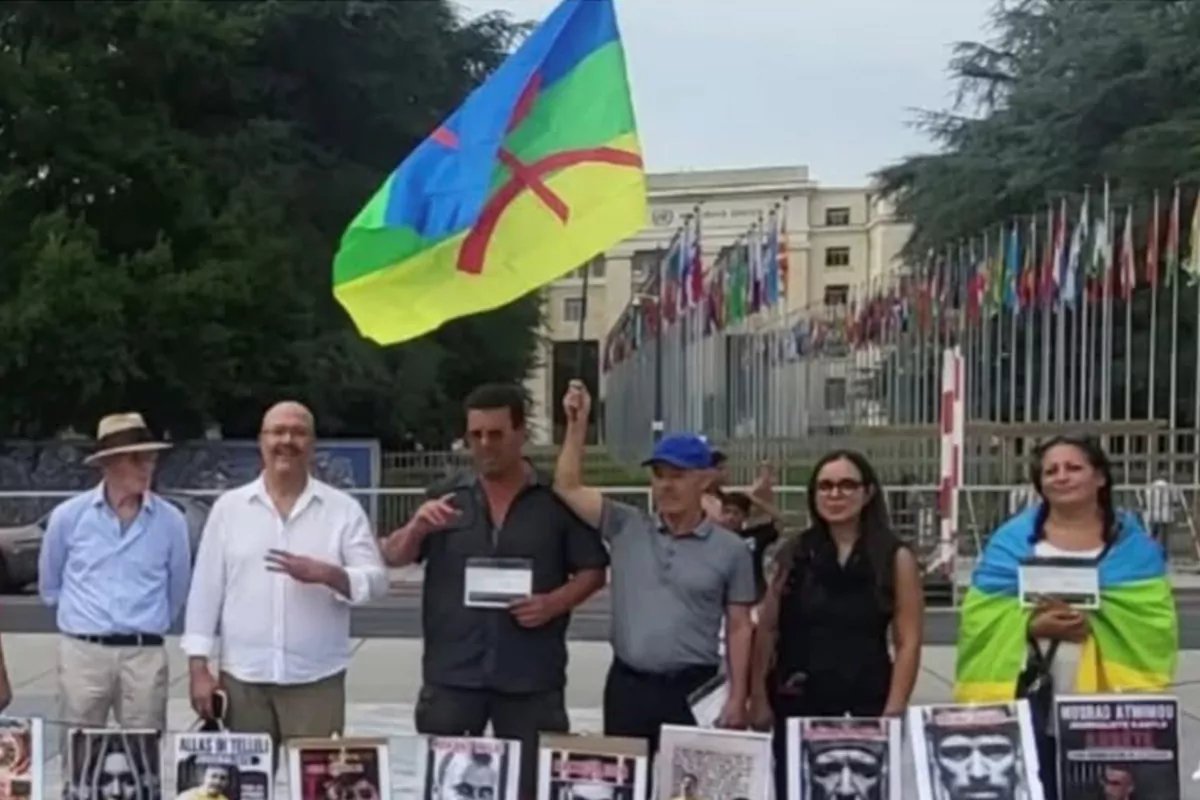
Alongside the formal sessions, the CMA held a sit-in on Place des Nations on July 13 to raise awareness of repression in Algeria and demand the release of Amazigh political prisoners. Notably, for the first time, the Algerian government sent a representative from the High Commission for Amazighity (HCA), who came to tout the “good health” of the Amazigh language in Algeria: a claim that stood in stark contrast to the testimony delivered by the CMA delegation throughout the session.
Full text of the press release
Active participation of the CMA in the 19th session of the UN Expert Mechanism on the Rights of Indigenous Peoples (EMRIP)
As scheduled, a delegation from the Congrès Mondial Amazigh/Amazigh World Congress (CMA)—comprising Nasser Abouzakhar (President), Belkacem Lounès (Secretary General), and Meriem Graba (member of the Federal Council)—actively participated in the 19th session of EMRIP, held from July 13 to 17, 2026, at the Palais des Nations in Geneva.
CMA representatives spoke on several topics included in the session’s agenda. Addressing the theme of “the rights of indigenous peoples in conflict and post-conflict situations,” Meriem Graba denounced “the heavy militarization of Kabylia, accompanied by counter-terrorism measures used by the Algerian government to repress the indigenous population.” She highlighted the excessive presence of various Algerian security forces “occupying our roads, fields, villages, and forests.” She added that the seizure of land and the plundering of indigenous communities’ natural resources are invariably accompanied by intense security-related pressure—citing the exploitation of the Tala-Hemza mine in Kabylia and the dispossession of Amazigh ancestral lands in Morocco as examples. The CMA representative concluded her remarks by firmly demanding the release of Amazigh political prisoners in Algeria and Morocco and, given the gravity of the situation, calling for Kabylia to be placed under UN protection.
Regarding the EMRIP theme of “country engagement,” Nasser Abouzakhar stated that “Amazigh territories are kept in a state of chronic underdevelopment, and the Amazigh people are deprived of genuine participation in decision-making processes, possessing no control over their ancestral lands, natural resources, their children’s education, and so forth.” He adds that it is imperative to conclude agreements between the Amazigh people and states that would guarantee Amazigh rights as set out in international standards. He concludes by noting the invitation extended by the CMA to the UN Expert Mechanism to visit the countries of Tamazgha (North Africa) and to urge governments to respect Amazigh rights as outlined in the UN Declaration on the Rights of Indigenous Peoples and other international legal instruments.
Addressing the theme of “artificial intelligence and the rights of indigenous peoples,” Nasser Abouzakhar also spoke on behalf of the CMA, asserting at the outset that “indigenous peoples must retain authority over how their data and knowledge are collected, stored, analyzed, shared, and used by governments, private companies, and artificial intelligence systems.” He adds that indigenous peoples’ data are not merely technical resources but “constitute our heritage, form part of our collective identity, and safeguard our future.” They encompass our knowledge systems, know-how, language, lands, and natural resources. This data belongs to us, and we must therefore have full control over it. He announces that the CMA is pleased to unveil the development and upcoming launch of the “CMA Indigenous Smart Governance Platform.” This initiative was designed as a practical digital governance platform intended to support indigenous institutions in exercising their rights to self-governance, data governance, and sustainable development. The platform will provide indigenous organizations with various digital tools for land management, policy development, legal support, environmental monitoring, institutional capacity building, multilingual knowledge management, and AI-assisted decision support. He adds: « The CMA looks forward to collaborating with the Expert Mechanism, the Permanent Forum, the Special Rapporteur, and Indigenous peoples and their institutions to ensure that AI serves as an instrument of justice, cultural resilience, and self-determined development, rather than a new source of exclusion ».
Speaking on the topic of enhancing Indigenous Peoples’ participation at the United Nations, Belkacem Lounès welcomed the progress made—notably the participation of Indigenous Peoples in the work of the Human Rights Council (HRC) for the first time in 2025, in their capacity as “Peoples.” He emphasized the urgent need to accelerate this process to ensure the full and effective participation of Indigenous Peoples at the United Nations becomes a reality sooner. He concluded his remarks by strongly urging all UN bodies—including the Expert Mechanism and treaty bodies—to press the relevant States to legally recognize Indigenous Peoples.
Belkacem Lounès also addressed the International Decade of Indigenous Languages. He noted that while the Decade’s steering committee had adopted a global action plan, the plan lacked a budget. Due to this lack of funding, the global action plan has remained merely a promise. At the national level, only about twenty action plans have been adopted by States—representing roughly 10% of the world’s countries—with none in North Africa. Regarding implementation, measures in many countries remain purely symbolic. Even the law fails to protect Indigenous languages; this is the case, for instance, with the Amazigh language in Morocco and Algeria, where—despite holding official language status—it remains marginalized and critically endangered, lacking any real support capable of ensuring its long-term survival. The CMA representative then called upon the Expert Mechanism, the Permanent Forum, and the Special Rapporteur to exert firm pressure on governments to fulfill their responsibilities in this regard. Speaking as an Amazigh, he also addressed fellow Indigenous representatives, reminding them that “Indigenous languages are, first and foremost, our languages, and we are therefore the ones most directly concerned.” “We must be much more proactive and committed to saving our languages.” He concluded with this invitation: “Next year, we will be at the midpoint of this decade. I invite us all to make this milestone a significant moment—a decisive global event—to revitalize the Decade of Indigenous Languages and enable it to fully play its role in the revitalization, protection, and promotion of our languages.”
Regarding proposals to be submitted to the Human Rights Council (HRC), Meriem Graba presented two proposals on behalf of the CMA:
The first is to establish a permanent agenda item for sessions of the Expert Mechanism on the Rights of Indigenous Peoples (EMRIP) and the HRC, titled “The Voice of Indigenous Victims.” This would allow indigenous representatives to directly share testimonies regarding the most serious human rights violations—such as those faced by Amazigh people who have been arrested, imprisoned, exiled, sentenced to death, or killed. Just last week, 74-year-old peace activist Saïd Bissaha was sentenced to ten years in prison for a simple social media post, while journalist Mourad Atmimou was imprisoned for denouncing an act of censorship. Civilian Tuareg populations in Azawad are also falling victim to a genocidal policy perpetrated with impunity by the Malian army and Africa Corps mercenaries.
The second proposal concerns the time allocated to the Special Rapporteur on the Rights of Indigenous Peoples and to the general debate on indigenous issues. Current time allocations are wholly insufficient for fruitful dialogue; therefore, we propose doubling the allotted time.
Regarding the 20th anniversary of the United Nations Declaration on the Rights of Indigenous Peoples (UNDRIP), to be celebrated in 2027, Nasser Abouzakhar views this as a valuable opportunity to examine the actual state of indigenous peoples’ rights two decades after the Declaration’s adoption. He asserts that across the North Africa region, Amazigh communities continue to face restrictions regarding their language, a lack of recognition for their representative institutions, barriers to participation in public life, the seizure of their lands and natural resources, discrimination, and brutal repression—particularly in countries like Algeria and, to a lesser extent, Morocco. This reality stands in stark contrast to the commitments enshrined in the UNDRIP. Given this regrettable situation, the implementation of the UNDRIP is urgent and must be a priority. The Congrès Mondial Amazigh/Amazigh World Congress therefore calls for a number of concrete measures:
– The UN should urge States to develop—in partnership with Indigenous peoples—national action plans for the implementation of UNDRIP, complete with measurable goals and regular monitoring,
– States should undertake a systematic review of their national legislation to ensure its compatibility with the rights recognized in UNDRIP, particularly regarding Indigenous languages, education, land rights, participation, the right to self-determination, the right to free, prior, and informed consent, human rights, and justice,
– The EMRIP should strengthen its concrete engagement with countries by supporting implementation missions, providing technical advice, and establishing monitoring mechanisms that yield measurable progress,
– The UN should adopt responsible digital innovation. Artificial intelligence can assist Indigenous peoples in documenting violations, analyzing legislation, preserving Indigenous knowledge and languages, strengthening evidence-based advocacy, and ensuring data governance.
Alongside these activities carried out during the 19th session of EMRIP, members of the CMA delegation participated in several side events organized by Indigenous institutions and organizations, as well as NGOs. As previously announced, on July 13, the CMA organized an awareness-raising sit-in at the Place des Nations in Geneva regarding the repression in Algeria and calling for the release of Amazigh political prisoners in Algeria and Morocco.
It should also be noted that, for the first time, the Algerian government sent a representative from the High Commission for Amazighity (HCA) to—for anyone willing to believe it—proclaim the healthy state of the Amazigh language in Algeria and outline government measures aimed at promoting Tamazight.
Geneva, July 18, 2026.
The CMA Secretariat.
Note: You can also follow a summary of this session via the program produced by TQ5 featuring the three CMA delegates to Emrip.